

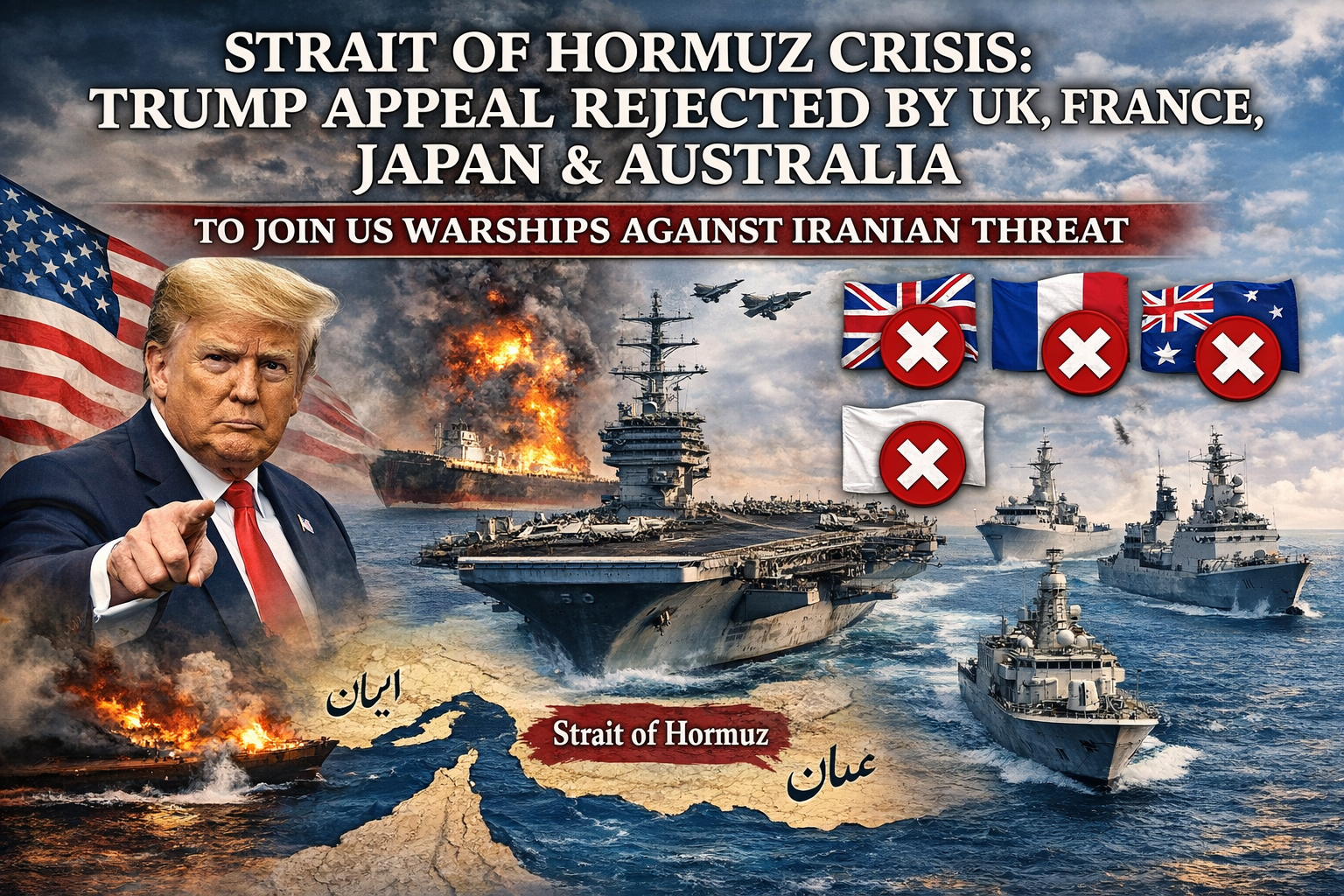
Washington/Tehran/London – In a significant diplomatic setback for the United States, the Strait of Hormuz crisis Trump warship appeal UK France Japan Australia reject has left Washington scrambling to secure a vital global waterway without major allied support. President Donald Trump’s urgent appeal for international naval assistance to reopen and secure the Strait of Hormuz has been met with refusal from key allies, even as the crisis deepens with attacks on oil tankers and nearly 1,000 commercial vessels stranded.
The confirmation that Strait of Hormuz crisis Trump warship appeal UK France Japan Australia reject his request represents a major blow to American efforts to project collective naval power against Iran, which has closed the strategic waterway in retaliation for US-Israel strikes that killed Supreme Leader Ayatollah Ali Khamenei and hundreds of Iranian civilians.
Breaking: Strait of Hormuz Crisis Trump Warship Appeal UK France Japan Australia Reject
According to reports from international media, President Trump took to his social media platform to issue an urgent appeal:
“Countries like South Korea, Japan, France, China, and Britain should participate in this effort because their economies also depend on Gulf oil supplies. We need to keep the Strait of Hormuz open and secure.”
However, the response has been overwhelmingly negative, with uk rejects us military request leading the way. British Prime Minister Keir Starmer personally informed Trump of the decision, according to UK newspaper reports. The japan refuses warship deployment followed shortly after, with Tokyo citing constitutional constraints and domestic political considerations.
The australia denies naval support came from Canberra, with officials stating that Australian naval assets are already stretched thin in the Indo-Pacific. france rejects hormuz mission completed the picture of allied refusal, with Paris emphasizing the need for diplomatic solutions rather than military escalation.
The Scale of the Crisis
The Strait of Hormuz crisis Trump warship appeal UK France Japan Australia reject unfolds against a backdrop of severe disruption:
1000 ships stranded hormuz:
- Approximately 1,000 commercial vessels unable to transit
- Oil tankers carrying millions of barrels stranded
- LNG carriers from Qatar trapped
- Container ships with goods delayed
- Insurance costs skyrocketing
oil tankers attacked hormuz:
- At least 10 oil tankers attacked or targeted since conflict began
- Some successfully hit, others narrowly escaping
- Crews evacuated from damaged vessels
- Environmental disaster risks mounting
- Shipping companies suspending Gulf operations
The iran blocks strait of hormuz action has effectively cut off 20% of global oil supply, sending prices to record highs above $180 per barrel.
Allied Refusals: Why Key Partners Said No
The Strait of Hormuz crisis Trump warship appeal UK France Japan Australia reject reveals deep divisions in the international response:
United Kingdom:
- Prime Minister Starmer personally declined Trump’s request
- Concerns about being drawn into wider war
- Royal Navy already overstretched
- Focus on European security priorities
- Preference for diplomatic channels
Japan:
- Constitutional constraints on collective self-defense
- Reliance on Iranian oil historically
- Desire to maintain diplomatic relations with Tehran
- Public opposition to new military commitments
- Focus on protecting own ships only
France:
- Macron government emphasizing diplomacy
- European autonomy from US military decisions
- Concerns about escalation without UN mandate
- Focus on Mediterranean and African priorities
- Skepticism about military solution
Australia:
- Naval assets committed to Indo-Pacific
- AUKUS submarine program priority
- Distance from Middle East contingencies
- Domestic political considerations
- Preference for multilateral UN framework
Germany (not requested but commented):
- Foreign Minister Johann Wadephul expressed skepticism
- “Germany does not want to be part of any new military action”
- Emphasis on diplomatic solutions
Iran’s Position: Opening Statements and Challenges
As the Strait of Hormuz crisis Trump warship appeal UK France Japan Australia reject unfolds, Iran has adopted a multi-faceted approach:
iran foreign minister statement from Abbas Araghchi:
“Several countries have contacted Iran regarding safe passage for their vessels. However, the final decision in this regard will be made by the Iranian military.”
This indicates that Iran is open to negotiations on a case-by-case basis while maintaining strategic ambiguity about overall access.
irgc challenges us navy statement from IRGC spokesman Ali Mohammad:
“If America thinks that the Iranian navy has been destroyed, let them send their ships into the Persian Gulf and see for themselves.”
This direct challenge to US naval power suggests Iran remains confident in its ability to defend the waterway despite American strikes.
India’s Successful Negotiation
Amid the Strait of Hormuz crisis Trump warship appeal UK France Japan Australia reject, India has achieved a significant diplomatic breakthrough:
india tankers allowed passage confirmed by Foreign Minister S. Jaishankar:
- Two Indian-flagged gas tankers granted permission
- Result of direct negotiations between New Delhi and Tehran
- Demonstrates Iran’s willingness to make exceptions
- Could serve as model for other nations
- India maintains historical ties with both US and Iran
The indian foreign minister statement highlights that diplomatic engagement with Tehran remains possible even amid active conflict.
The Human and Economic Toll
Beyond the geopolitics of Strait of Hormuz crisis Trump warship appeal UK France Japan Australia reject, the human cost continues to mount:
iran lebanon death toll exceeds 600:
- Over 500 dead in Iran, including 148 children in Minab school attack
- More than 100 dead in Lebanon
- Thousands wounded
- Hospitals overwhelmed
- Humanitarian crisis deepening
global oil prices spike:
- Brent crude above $180 per barrel
- WTI above $175 per barrel
- Gasoline prices soaring worldwide
- Inflation fears intensifying
- Central banks facing impossible choices
stranded vessels humanitarian situation:
- Crews running low on supplies
- Food and water shortages on some ships
- Medical emergencies unable to reach port
- Families of crew members anxious
- Insurance and legal complications mounting
Trump’s Diplomatic Dilemma
The Strait of Hormuz crisis Trump warship appeal UK France Japan Australia reject leaves President Trump in a difficult position:
Option 1: Go It Alone
- US Navy acts unilaterally to reopen strait
- Risks direct confrontation with Iran
- No allied support or burden-sharing
- Domestic political criticism
- International law questions
Option 2: Accept Limited Access
- Allow Iran to control passage
- Negotiate case-by-case releases
- Accept strategic defeat
- Damage US credibility
- Embolden Iran further
Option 3: Intensify Military Pressure
- Strike Iranian naval and missile capabilities
- Risk escalation to ground war
- Further strain defense budget
- No guarantee of success
- Potential for wider conflict
Option 4: Diplomatic Engagement
- Direct negotiations with Iran
- Requires concessions
- Political costs at home
- Allies may welcome move
- Uncertain outcome
International Reaction to Allied Refusals
The Strait of Hormuz crisis Trump warship appeal UK France Japan Australia reject has drawn varied international responses:
russia:
- Welcomes allied refusal as “wise decision”
- Offers alternative security framework
- Positions itself as diplomatic alternative
- Strengthens ties with Iran
china:
- Maintains strategic silence
- Continues citizen evacuations
- Protects energy interests quietly
- Avoids taking sides publicly
european union:
- Emergency energy meeting convened
- Discussing strategic reserves release
- Coordinating diplomatic approach
- Concerned about economic impact
gulf states:
- Privately urging US restraint
- Publicly maintaining solidarity
- Fear being caught in crossfire
- Exploring independent options
Analysis: Why Allies Said No
The Strait of Hormuz crisis Trump warship appeal UK France Japan Australia reject reflects deeper strategic calculations:
1. War Fatigue
Two decades of Middle East wars have left allies reluctant to engage in new conflicts with unclear objectives.
2. Iran Ties
Many allies maintain diplomatic and economic relationships with Iran they wish to preserve.
3. US Credibility
Trump’s unpredictable leadership style makes allies hesitant to commit to open-ended missions.
4. Domestic Politics
Leaders face public opposition to new military adventures.
5. Alternative Priorities
Europe focuses on Ukraine, Asia focuses on China, Australia focuses on Pacific.
6. Doubts About Strategy
Allies question whether military force can achieve lasting solution.
What Happens Next?
Following the Strait of Hormuz crisis Trump warship appeal UK France Japan Australia reject, several developments are likely:
- US Unilateral Action: America may act alone to reopen strait
- Diplomatic Track: Intensified efforts through UN and other channels
- Selective Passage: More countries negotiate directly with Iran like India
- Economic Crisis: Prolonged closure devastates global economy
- Naval Confrontation: Increased risk of US-Iran naval clashes
- Evacuations: More countries follow US, Canada in citizen removal
- Oil Rationing: Importing countries may impose fuel restrictions
The IRGC Challenge
The irgc challenges us navy statement adds a personal dimension to the crisis:
“If America thinks that the Iranian navy has been destroyed, let them send their ships into the Persian Gulf and see for themselves.”
This challenge puts the US in a difficult position:
- Ignoring it appears weak
- Accepting it risks confrontation
- Timing and manner of response crucial
- Domestic audience watching
- International community observing
Conclusion
The Strait of Hormuz crisis Trump warship appeal UK France Japan Australia reject represents a pivotal moment in the ongoing Iran-US conflict. With key allies refusing to join a naval coalition, nearly 1,000 ships stranded, at least 10 tankers attacked, and global oil prices soaring past $180, the United States faces one of its most serious strategic dilemmas in decades.
As Iran allows selective passage to Indian tankers while challenging the US Navy to enter the Persian Gulf, as Britain, Japan, France, and Australia decline Washington’s request, and as the human toll of the wider conflict exceeds 600 dead including 148 children, the path forward remains deeply uncertain.
The Strait of Hormuz crisis Trump warship appeal UK France Japan Australia reject may be remembered as the moment when America’s allies signaled that the era of automatic military support for US Middle East operations has ended. For President Trump, for the global economy, and for the hundreds of thousands whose livelihoods depend on the free flow of oil through the Strait, the consequences will be profound.
