

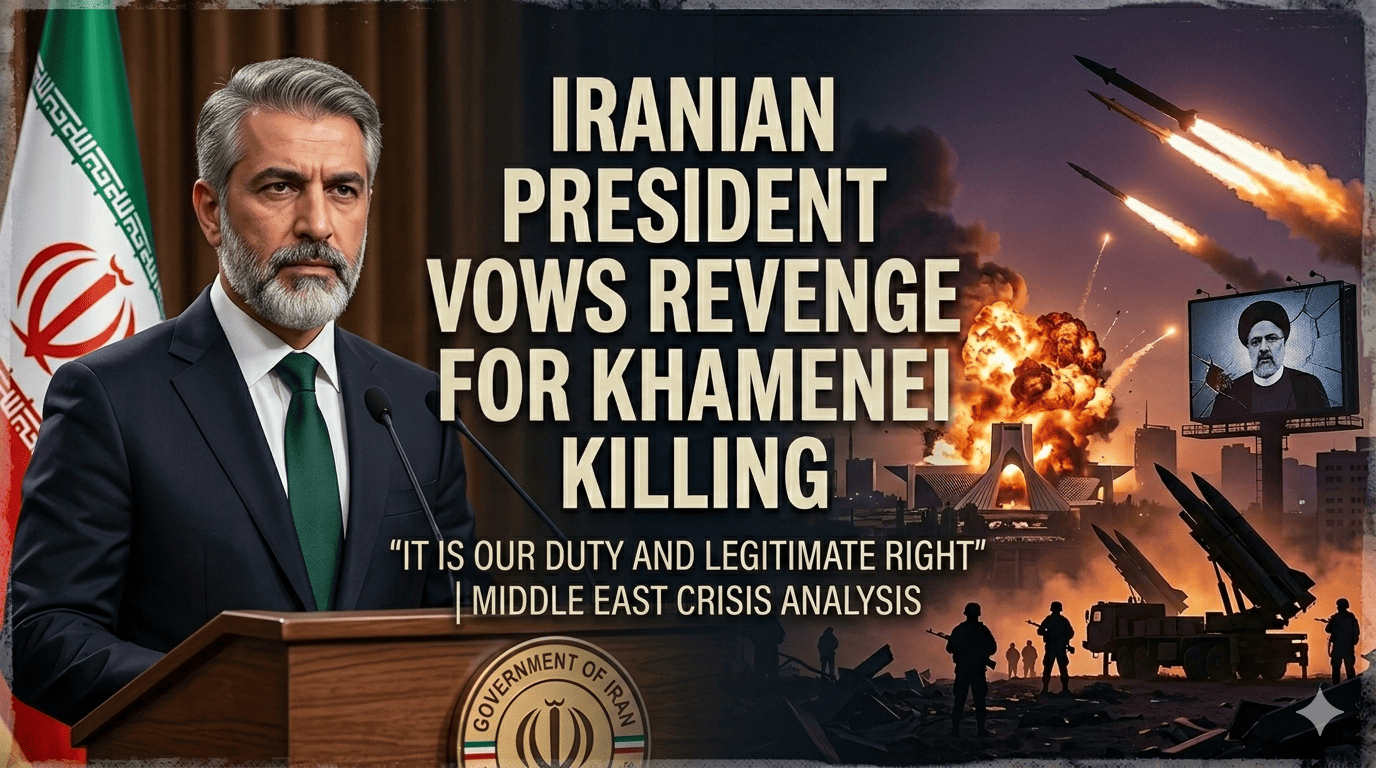
Tehran – In a powerful and emotionally charged address to the nation, the iranian president vows revenge khamenei killing, declaring that retaliating for the Supreme Leader’s assassination is the Islamic Republic’s sacred duty. The statement from masoud pezeshkian statement comes just hours after Iranian state media confirmed that ayatollah khamenei killed in us israel strike, sending shockwaves across the region and triggering fears of an imminent and devastating Iranian response.
As the world processes the historic confirmation that iranian president vows revenge khamenei killing, the Middle East holds its breath, anticipating the “most destructive operation in Iran’s history” promised by the IRGC. The iran revenge for khamenei now becomes the central focus of Iranian policy, with the president articulating a clear and uncompromising path forward.
Full Statement: Iranian President Vows Revenge for Khamenei Killing
In his official condolence message following the confirmation that iranian president vows revenge khamenei killing, Masoud Pezeshkian articulated a position that leaves no room for ambiguity about Iran’s intentions. The supreme leader assassination retaliation will be comprehensive and devastating, according to the president’s remarks.
“The Islamic Republic of Iran considers it its responsibility to exact justice and revenge from those responsible for this historic crime and those who ordered it.”
The iranian president vows revenge khamenei killing with the full weight of his office, stating that Iran will utilize “all its capabilities” to achieve this objective. This represents a formal declaration of intent from the highest levels of the Iranian government, moving beyond the initial IRGC statements to establish national policy.
The Context: Why Iranian President Vows Revenge for Khamenei Killing
To understand why the iranian president vows revenge khamenei killing with such vehemence, one must appreciate the unprecedented nature of the loss. Ayatollah Ali Khamenei led Iran for 36 years, succeeding the founder of the Islamic Republic, Ayatollah Khomeini. His iran supreme leader assassination removes the central figure around whom the entire political and religious system was organized.
The iranian president vows revenge khamenei killing not only as a political leader but as the inheritor of a revolutionary tradition. The khamenei death revenge becomes a matter of national honor and ideological imperative. For the Islamic Republic, failure to respond forcefully would signal weakness to enemies and disillusionment to supporters.
Masoud Pezeshkian’s Condolence Message
Before announcing retaliation, the iranian president vows revenge khamenei killing after first offering condolences to the nation. In his iranian president condolence message, Pezeshkian addressed the khamenei family condolences and the broader Iranian people:
“The president expressed condolences to the families of the departed leaders and the nation.”
This dual approach—mourning combined with vengeance—reflects the traditional Iranian response to the martyrdom of significant figures: grief alongside a sacred obligation to retaliate. The iranian president vows revenge khamenei killing while honoring his memory, framing the response as both justice and continuation of the Supreme Leader’s mission.
Regional Tensions Escalate
Following the announcement that the iranian president vows revenge khamenei killing, the region has braced for imminent escalation:
tehran response to strikes has now been formally articulated at the presidential level, moving from military statements to national policy. The iran retaliation threats are no longer vague warnings but official government position.
The middle east crisis update now includes the certainty of massive Iranian retaliation, with only the timing, targets, and methods remaining unknown. Regional militaries have been placed on highest alert, with air defense systems activated across the Gulf and in Israel.
iran israel war latest developments suggest that the conflict, which began with US-Israel strikes on Tehran, is about to enter a new and potentially more destructive phase. The iranian president vows revenge khamenei killing specifically names Israel and the United States as targets of this retaliation.
International Reaction
As the iranian president vows revenge khamenei killing, the international community has responded with a mixture of concern and diplomatic scrambling:
- The un security council emergency session continues, with members divided on how to respond to the escalating crisis.
- russia condemns us israel attack while also urging Iran to show restraint in its retaliation.
- china condemns us israel strike but calls for de-escalation from all parties.
- Western nations have advised their citizens to leave the region and reinforced security at diplomatic missions.
The international reaction to iran strike has been complicated by the confirmation of Khamenei’s death, which some nations view as a legitimate target while others condemn as assassination.
What Retaliation Might Look Like
Now that the iranian president vows revenge khamenei killing, analysts are assessing potential Iranian retaliatory options:
- Direct Missile Strikes: Iran may launch massive barrages at Israeli cities and US bases in the region, potentially using its most advanced ballistic missiles.
- Proxy Warfare: The iranian proxies response could involve coordinated attacks by Hezbollah, Iraqi militias, Syrian forces, and Yemen’s Houthis, opening multiple fronts simultaneously.
- Cyber Attacks: Iran may unleash devastating cyber operations against US and Israeli infrastructure, including power grids, financial systems, and transportation networks.
- Strait of Hormuz: Iran could attempt to close the strait of hormuz, disrupting global oil supplies and triggering an economic crisis.
- Terrorist Operations: Iranian intelligence may activate sleeper cells for attacks on Western targets globally.
The iran history most destructive operation claim suggests that whatever form the retaliation takes, it will be unprecedented in scale and coordination.
Domestic Iranian Reaction
The announcement that the iranian president vows revenge khamenei killing has been met with widespread approval across Iran’s political spectrum and general population:
- mashhad mourning crowds have transformed into rallies demanding revenge.
- shrine of imam reza video footage shows mourners chanting death to America and Israel.
- tehran explosions from ongoing conflict have not dampened public support for retaliation.
- Political factions, often divided, have united behind the president’s declaration.
The iran mourning 40 days will now proceed alongside military preparations, creating a unique atmosphere of grief and martial determination.
US and Israeli Preparedness
As the iranian president vows revenge khamenei killing, both the United States and Israel have taken defensive measures:
- us navy 5th fleet has been placed on highest alert, with vessels dispersed to reduce vulnerability.
- al udeid air base in Qatar and al dafra airbase uae have activated enhanced air defense protocols.
- us bases in bahrain attacked previously are now on maximum alert for follow-on strikes.
- Israel’s tel aviv defense ministry attack has prompted reinforcement of air defenses around critical infrastructure.
- The israeli prime minister statement following Khamenei’s death acknowledged the likelihood of retaliation and promised a forceful response to any attack.
Historical Parallels
When an iranian president vows revenge khamenei killing, it evokes memories of previous Iranian retaliation for assassinated leaders:
The qasem soleimani assassination comparison is inevitable. When the US killed the revered IRGC commander in 2020, Iran responded with ballistic missile strikes on US bases in Iraq. However, the current situation differs in scale—killing a head of state is orders of magnitude more significant than eliminating even a senior commander.
The iranian revolution 1979 created the system that Khamenei led. His death, followed by the iranian president vows revenge khamenei killing, suggests that the revolution’s vengeance imperative remains as strong as ever.
The Succession Question
While the iranian president vows revenge khamenei killing, the question of succession looms in the background:
The iran new supreme leader selection process will proceed under the assembly of experts iran, but this constitutional process may be overshadowed by the immediate demands of war and revenge. The iran succession crisis could be managed or exacerbated depending on how the retaliation unfolds.
Economic Implications
The confirmation that the iranian president vows revenge khamenei killing has already impacted global markets:
- oil prices spike as traders factor in the likelihood of supply disruptions from the Gulf.
- Global stock markets have fallen on war fears.
- Shipping companies are rerouting vessels away from the Persian Gulf.
- Insurance rates for regional shipping have skyrocketed.
The global markets impact will intensify if Iranian retaliation disrupts oil flows through the Strait of Hormuz.
Analysis: A Defining Moment
The declaration that the iranian president vows revenge khamenei killing represents a defining moment for the Islamic Republic. The regime’s credibility, both domestically and regionally, depends on its response to the assassination of its Supreme Leader. Failure to deliver devastating retaliation would undermine the very foundations of the revolutionary state.
However, the path chosen carries immense risk. Full-scale war with the United States and Israel could devastate Iran’s infrastructure, economy, and military. The iranian president vows revenge khamenei killing knowing that the response could trigger a conflict that none may be able to control.
What Happens Next?
In the hours and days following the announcement that the iranian president vows revenge khamenei killing, the world will watch for:
- Timing of Retaliation: Will Iran strike immediately or prepare a more deliberate, coordinated response?
- Target Selection: Will retaliation focus on Israel, US assets, or both?
- Scale of Attack: How does Iran define “most destructive operation”?
- US-Israel Response: How will the targeted nations respond to Iranian attacks?
- Diplomatic Efforts: Can the UN or other mediators prevent all-out war?
Conclusion
The declaration that the iranian president vows revenge khamenei killing transforms the Middle Eastern crisis from a military operation into a historic confrontation between Iran and its adversaries. With the full weight of the Iranian state now committed to retaliation, the region stands on the precipice of a conflict whose dimensions and duration no one can predict.
As Masoud Pezeshkian’s words echo across Iran and the world, the only certainty is that the coming days will bring violence on a scale not seen in decades. The iranian president vows revenge khamenei killing—and the world braces for the consequences.
This is a developing story. Stay tuned for continuous updates.
