

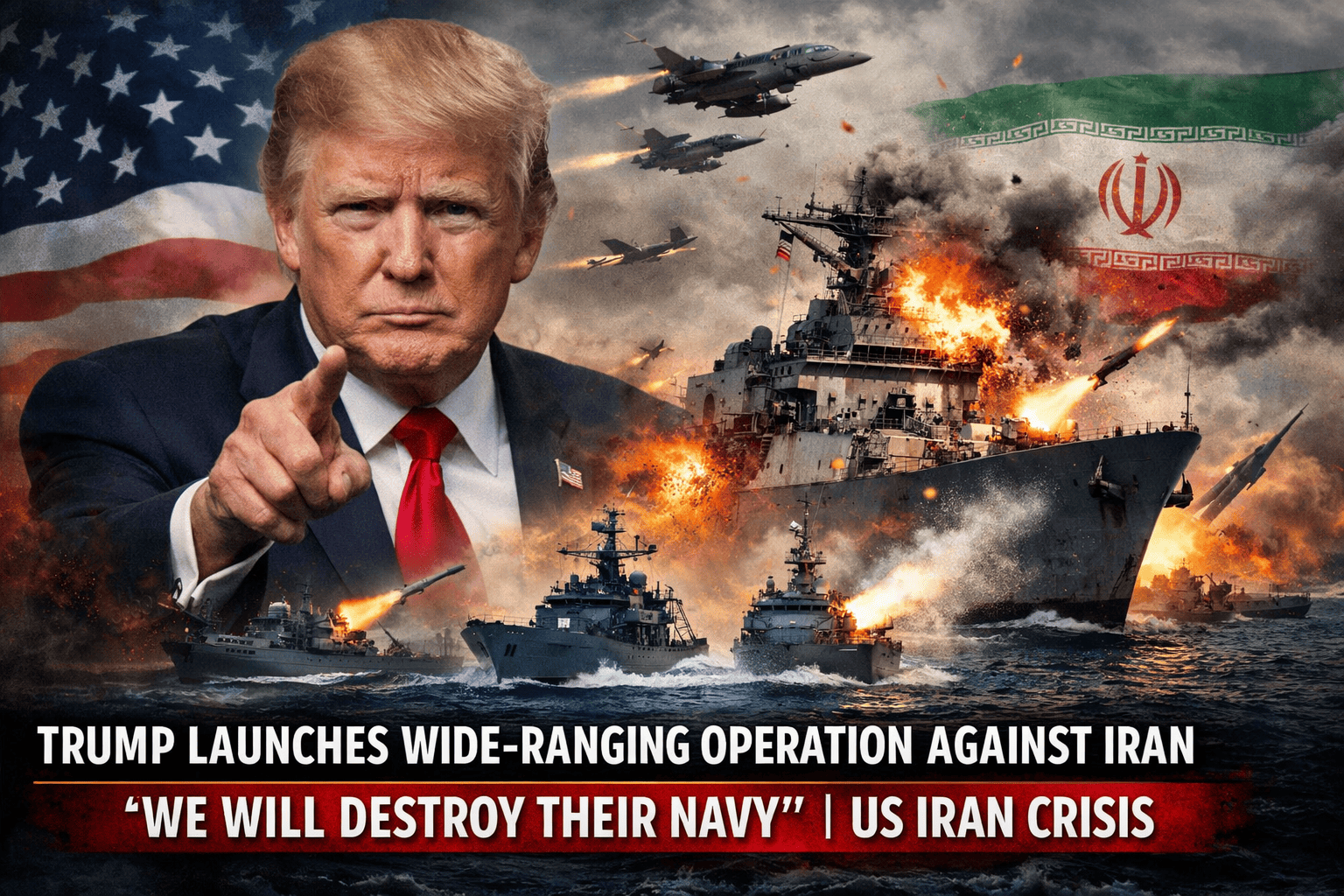
Washington, D.C.: In a dramatic and unprecedented escalation of hostilities, US President Donald Trump has announced the commencement of a “wide-ranging operation” against the Islamic Republic of Iran. The emergency declaration, made from the White House, signals a significant shift from strategic tension to direct, large-scale military engagement.
In an emergency address to the nation, President Trump confirmed that US forces have begun offensive actions against Iranian targets. While the statement was light on specific tactical details regarding ongoing strikes, it was heavy with the strategic objectives and ideological justifications for the operation.
“For decades, the regime in Tehran has chanted ‘Death to America’ and has been the primary instigator of attacks on American interests throughout the Middle East,” President Trump stated. He directly attributed regional instability and assaults on US assets to the Iranian government, framing the operation as a long-overdue response to years of hostility.
The President outlined a devastating and comprehensive set of military goals. “We are going to completely destroy the Iranian navy,” he declared. Acknowledging the high stakes of such an undertaking, he added, “This operation may come at a cost, including American lives, but we will not allow Iran to ever obtain a nuclear weapon. We will obliterate their missile program.”
This statement directly targets two of Iran’s primary conventional and strategic military capabilities: its naval power, which controls the vital Strait of Hormuz, and its ballistic missile program, which is considered the most powerful and diverse in the region.
An Ultimatum to the IRGC
In a crucial passage of his address, President Trump delivered a stark ultimatum directly to the Islamic Revolutionary Guard Corps (IRGC), the elite branch of Iran’s armed forces.
“If the Pasdaran [IRGC] surrenders, they will be granted a complete exemption,” Trump warned. “If they do not, they will face certain death.”
This offer creates a potential rift within the Iranian military structure, although analysts suggest the highly ideological IRGC is unlikely to accept such a public demand for capitulation. The President concluded his remarks by framing the conflict in absolute terms: “Iran has been attacking American targets for years. The United States will not allow an extremist regime to flourish.”
Analysis and Context
President Trump’s announcement marks a significant departure from previous US policy, which often relied on sanctions, cyber warfare, and limited strikes against proxy forces. A direct order to destroy a nation’s navy and missile program constitutes an act of war with the goal of regime-level military defeat.
Key Implications:
- Naval Confrontation: The US Navy’s 5th Fleet, based in Bahrain, is now likely engaged in direct combat with Iranian naval assets in the Persian Gulf.
- Nuclear Threshold: By explicitly stating the goal of preventing nuclear weapons, the US may be targeting Iran’s nuclear facilities, a move that risks spreading radiation and provoking a regional war.
- IRGC Response: The IRGC is known for its asymmetric warfare capabilities. An attack on its existence will likely trigger retaliatory strikes via proxies in Iraq, Syria, Yemen, and Lebanon, as well as direct missile barrages against US bases and Israel.
The world now watches to see if this “wide-ranging operation” remains limited to specific military targets or expands into a full-scale invasion or occupation, with consequences that will reshape the Middle East for a generation.
