

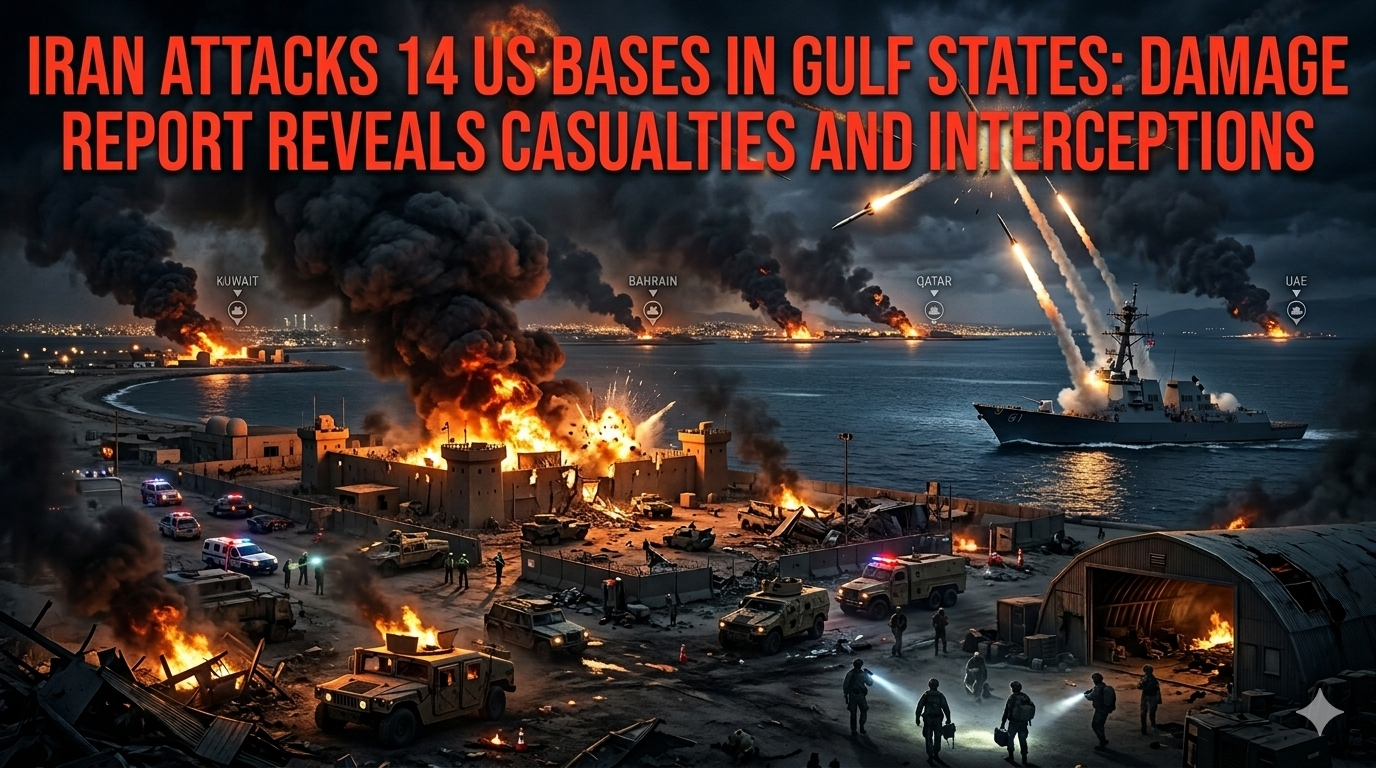
Dubai/Kuwait City/Manama – In one of the most extensive retaliatory operations since the conflict began, a new Iran attacks 14 US bases Gulf states damage report reveals the scope and impact of Tehran’s military response to the assassination of Supreme Leader Ayatollah Ali Khamenei. The Islamic Revolutionary Guard Corps (IRGC) launched coordinated missile and drone strikes against American military installations across five Gulf nations, with varying degrees of success and damage.
The comprehensive iran missile strikes gulf campaign targeted us bases in gulf attacked across the United Arab Emirates, Kuwait, Bahrain, Qatar, and Saudi Arabia. While Iran claims hundreds of casualties, the ground reality reported by host nations presents a more nuanced picture of interceptions, limited damage, and isolated casualties.
Overview: Iran Attacks 14 US Bases in Gulf States
According to international news agencies, the Iran attacks 14 US bases Gulf states damage report documents strikes on American facilities in five countries:
| Country | Bases Targeted | Damage Reported |
|---|---|---|
| UAE | Multiple | Missiles intercepted; debris killed 1 Pakistani national |
| Kuwait | Ali Al Salem Airbase | 3 soldiers wounded; minor facility damage |
| Bahrain | US Fifth Fleet HQ | Attack repelled; no casualties reported |
| Qatar | Multiple facilities | Airspace closed; flights suspended |
| Saudi Arabia | Riyadh & Eastern Region | Missiles intercepted; no major casualties |
The iran missile strikes gulf operation represents Iran’s attempt to project power across the region while punishing nations hosting American forces.
Kuwait: Ali Al Salem Airbase Hit
The kuwait ali al salem airbase hit represents one of the few successful penetrations of Gulf air defenses. According to Kuwait’s Ministry of Defense:
- Three military personnel were wounded in the attack
- The airbase’s infrastructure sustained minor damage
- Wounded soldiers are now out of danger
- Operational readiness unaffected
- Military capability remains fully intact
The kuwait defense ministry statement confirmed that while Iran attacks 14 US bases Gulf states included Kuwait, the damage was limited and contained. Ali Al Salem Airbase hosts US Air Force assets and is critical to regional operations.
United Arab Emirates: Interceptions and Tragedy
In the UAE, air defense systems proved highly effective as uae intercepts iranian missiles before they could reach their targets. However, the uae missile debris casualties resulted in tragedy:
- Multiple Iranian missiles destroyed in flight
- Falling debris struck a residential area
- One Pakistani national was killed
- No damage to military facilities reported
- Abu Dhabi’s air defense systems performed successfully
The uae attack response has been measured, with officials condemning the strikes while acknowledging the effectiveness of their defenses. The death of the Pakistani national has added a diplomatic dimension, with Islamabad likely to seek explanations from both Tehran and Abu Dhabi.
Bahrain: Fifth Fleet Targeted
The bahrain fifth fleet attack targeted the headquarters of the US Navy’s most important regional command. The us navy 5th fleet is responsible for:
- Patrol of the Persian Gulf
- Protection of oil shipping lanes
- Counter-piracy operations
- Regional naval deterrence
According to Bahraini officials, the attack was repelled with bahrain no casualties reported. Air defense systems successfully engaged incoming threats, and the fleet’s operational capability remains unchanged. Bahrain’s civil defense activated sirens, warning citizens to take shelter during the attack.
Saudi Arabia: Intercepting the Barrage
saudi arabia intercepts missiles aimed at Riyadh and the Eastern Province, home to critical oil infrastructure. According to saudi defense officials:
- Multiple ballistic missiles engaged
- Air defense systems successful
- No major casualties reported
- Civilian areas protected
- Oil facilities undamaged
The saudi eastern province attack attempted to strike the heart of Saudi energy production, though Iranian missiles were stopped before reaching their targets. Riyadh has condemned the strikes while reaffirming its defensive capabilities.
Qatar: Airspace Closed, Flights Suspended
qatar airspace closed temporarily as Iranian missiles approached, with hamad international airport flights suspended for several hours. The qatar attack condemnation came swiftly from Doha officials:
- Air defense systems activated
- Multiple facilities on alert
- Al Udeid Air Base (hosting CENTCOM) on highest alert
- Flights diverted or delayed
- Normal operations gradually resuming
Qatar hosts the forward headquarters of US Central Command (CENTCOM) at Al Udeid, making it a high-value target in any Iran attacks 14 US bases Gulf states campaign.
Jordan and Syria: Drones Downed
Beyond the Gulf, jordan shoots down iranian drones that approached its airspace, while syria downs iranian drones in a complicating development. Both nations issued warnings:
jordan warning to iran:
- Air defense forces engaged multiple drones
- National security violations will not be tolerated
- Any further incursions will face severe response
syria response to iran:
- In a surprising development, Syrian air defenses shot down Iranian drones
- Damascus reportedly warned Tehran against violating sovereignty
- The incident highlights complex relationships between Iran and the Syrian government
The involvement of Jordan and Syria demonstrates how the conflict risks expanding beyond the original participants.
Iran’s Claims vs. Ground Reality
While Iran attacks 14 US bases Gulf states damage report from Iranian sources claims “hundreds of casualties,” the evidence from Gulf nations suggests a different picture:
| Claim | Iranian Version | Ground Reality |
|---|---|---|
| Casualties | Hundreds killed | 1 confirmed death (Pakistan national), 3 wounded (Kuwait) |
| Base Damage | Severe destruction | Minor facility damage at Ali Al Salem |
| Fifth Fleet | Crippled | Fully operational |
| Saudi Oil | Targeted | Unharmed |
| Air Defenses | Overwhelmed | Mostly effective |
The iran missile strikes gulf operation achieved psychological impact but limited physical destruction, suggesting either Iranian limitations or effective Gulf-American air defense cooperation.
Gulf States’ Responses
Each targeted nation has responded according to its national interests:
UAE statement on iran attacks:
- Strong condemnation of the strikes
- Confirmation of effective air defense
- Expression of solidarity with international coalition
- Call for restraint and de-escalation
kuwait defense ministry statement:
- Confirmation of casualties and damage
- Assertion of right to self-defense
- Coordination with international partners
- Focus on protecting national sovereignty
qatar attack condemnation:
- Denunciation of violence
- Protection of Qatari territory
- Continued hosting of US forces
- Diplomatic channels remain open
saudi arabia response to strikes:
- Condemnation of Iranian aggression
- Praise for air defense forces
- Commitment to protect holy sites and oil facilities
- Coordination with US military
bahrain official reaction:
- Sirens activated as precaution
- No damage reported
- Solidarity with coalition forces
- Warning to citizens to remain vigilant
Regional Diplomatic Fallout
The Iran attacks 14 US bases Gulf states damage report has triggered immediate diplomatic consequences:
- GCC emergency meeting requested by multiple members
- Arab League condemnation expected
- Organization of Islamic Cooperation may convene
- UN Security Council to review the attacks
- Bilateral tensions between Iran and Gulf states escalate
The strikes have united Gulf nations in opposition to Iran, even as they individually manage their relationships with Tehran.
Strategic Implications
The iran missile strikes gulf operation reveals several strategic realities:
1. Air Defense Effectiveness:
Gulf states, with American support, have developed robust air defense capabilities. Most Iranian missiles were intercepted, limiting damage.
2. Iranian Reach:
Iran demonstrated ability to strike targets across the Gulf simultaneously, a significant operational achievement despite limited success.
3. Civilian Risk:
The death of a Pakistani national from debris highlights the danger to civilians even when military targets are the objective.
4. Regional Unity:
Gulf states have largely coordinated their responses, suggesting potential for collective security arrangements.
5. Escalation Risk:
Each strike and counter-strike increases the chance of miscalculation and broader war.
The Pakistani Dimension
The death of a Pakistani national in the UAE adds complexity. pakistan citizen killed in uae by Iranian missile debris creates diplomatic challenges:
- Islamabad may demand explanation from Tehran
- Pakistan has historically maintained neutrality in Gulf conflicts
- Public opinion may pressure government to respond
- Large Pakistani expatriate community in Gulf at risk
- Potential for strained Pakistan-Iran relations
What Comes Next?
Following the Iran attacks 14 US bases Gulf states damage report, several developments are likely:
- US Reinforcement: Additional air defense assets may be deployed to Gulf states
- Diplomatic Offensive: Washington will seek GCC unity against Iran
- Iranian Messaging: Tehran will claim victory despite limited damage
- Proportional Response: Gulf states may retaliate diplomatically or economically
- Continued Tensions: The conflict shows no signs of de-escalation
Analysis: A Strategic Assessment
The iran missile strikes gulf operation represents both achievement and limitation for Iran:
Achievements:
- Demonstrated ability to coordinate multi-national strikes
- Proved missile and drone reach across Gulf
- Created psychological impact
- Responded to Supreme Leader’s assassination
- Maintained domestic support through show of strength
Limitations:
- Most missiles intercepted
- Limited physical damage
- Unified Gulf states against Iran
- Highlighted air defense effectiveness
- Caused civilian death that may backfire diplomatically
Conclusion
The Iran attacks 14 US bases Gulf states damage report reveals a complex picture of successful interceptions, limited damage, and isolated tragedy. While Iran achieved its objective of demonstrating capability and responding to Khamenei’s assassination, the physical impact fell far short of Tehran’s claimed “hundreds of casualties.”
For Gulf states, the attacks validated years of investment in air defense systems and cooperation with the United States. For the United States, the effectiveness of its partners’ defenses provides some reassurance. For the region, the attacks represent another dangerous step toward wider conflict.
As the world processes this iran missile strikes gulf campaign, the only certainty is that the Middle East remains on a knife’s edge, with each exchange bringing the possibility of escalation closer to reality.
