

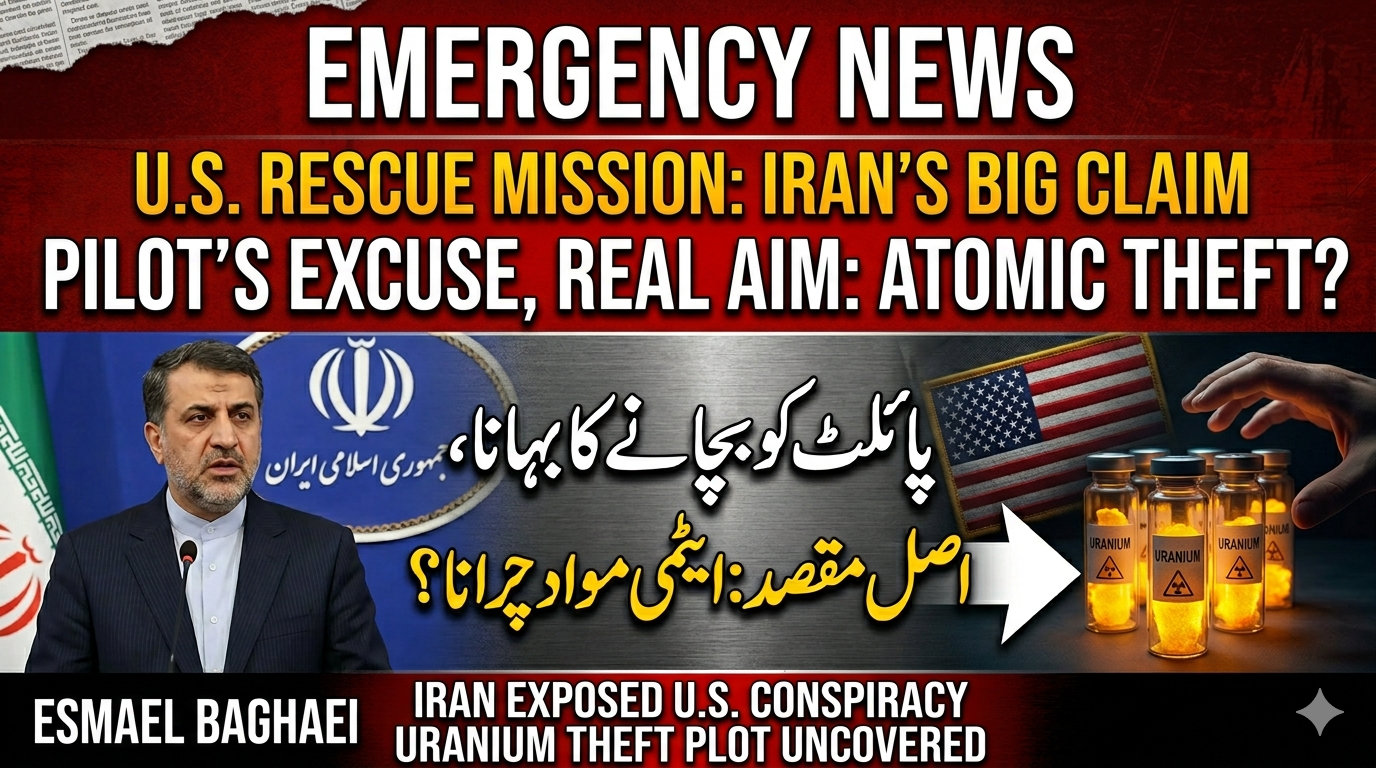
Tehran/Washington – In a dramatic escalation of the information war between the two nations, Iran claims US rescue mission cover enriched uranium theft following a controversial American military operation inside Iranian territory. Iran’s Foreign Ministry spokesman Ismail Baghaei alleged during a press conference that the US mission, officially described as a rescue operation for a missing pilot, was actually a cover for attempting to steal enriched uranium from Iranian nuclear facilities.
Tehran/Washington – In a dramatic escalation of the information war between the two nations, Iran claims US rescue mission cover enriched uranium theft following a controversial American military operation inside Iranian territory. Iran’s Foreign Ministry spokesman Ismail Baghaei alleged during a press conference that the US mission, officially described as a rescue operation for a missing pilot, was actually a cover for attempting to steal enriched uranium from Iranian nuclear facilities.
The stunning allegation that Iran claims US rescue mission cover enriched uranium theft comes just days after President Donald Trump hailed a large-scale American military operation to extract US personnel from Iran as “historic.” Tehran’s accusations threaten to further inflame tensions already at their highest point in decades.
Breaking: Iran Claims US Rescue Mission Cover Enriched Uranium Theft
According to reports from international news agencies, ismail baghaei statement delivered a detailed accusation against the United States during a press conference in Tehran. The iran foreign ministry spokesman alleged that the true purpose of the American operation was not humanitarian but rather espionage and theft.
“Under the guise of this so-called rescue mission, American forces attempted to land at a location where there was no evidence of any pilot’s presence. The alleged location of the pilot, contrary to US claims, is very far from the site of this mission. This proves that American forces were seeking access to nuclear materials.”
The iran claims us rescue mission cover enriched uranium theft allegation represents a serious charge that, if proven, would constitute a major violation of international law and Iranian sovereignty.
The US Version: Trump’s “Historic” Rescue Operation
Prior to Iran’s accusations, President Trump had described the trump rescue operation in glowing terms:
“I instructed the military to take every possible measure to bring our personnel back safely. This was a historic operation.”
Trump detailed the scale of the us military operation iran:
-
- 21 US military aircraft used in the primary rescue mission
-
- A second larger operation involved 155 aircraft
-
- 4 bomber aircraft
-
- 64 fighter aircraft
-
- 48 aerial refueling tankers
-
- 13 rescue aircraft
The us aircraft deployed iran numbers suggest one of the largest single-day air operations since the conflict began, involving assets from multiple bases across the region.
Iran’s Counter-Narrative
The iran claims US rescue mission cover enriched uranium theft narrative directly challenges the American version of events:
Key Iranian Allegations:
-
- No pilot or crash evidence at the landing site
-
- The claimed pilot location is far from where US forces landed
-
- The operation targeted areas near nuclear facilities
-
- The mission was a “charade” to deceive the international community
-
- US forces were seeking access to iran enriched uranium storage facilities
ismail baghaei statement continued:
“The Trump administration tried to throw dust in the eyes of the international community under the cover of a pilot rescue mission. We strongly condemn this failed conspiracy.”
Strategic Context: Why Iran Claims US Rescue Mission Cover Enriched Uranium Theft
The timing and nature of Iran claims US rescue mission cover enriched uranium theft must be understood within the broader strategic context:
1. Nuclear Program Vulnerability
Iran’s nuclear facilities have been a primary target of US and Israeli strikes. Any American ground operation near these sites would be treated as an existential threat.
2. Information War
Both sides are fighting a narrative battle. Iran’s accusation serves to:
-
- Discredit US military operations
-
- Rally domestic support
-
- Justify future retaliation
-
- Warn against further incursions
3. Precedent Setting
If the US conducted ground operations inside Iran without detection, it would represent a major intelligence failure. Iran may be attempting to demonstrate awareness of US movements.
4. Nuclear Negotiation Leverage
Accusing the US of attempted theft strengthens Iran’s position that its nuclear materials must be protected, potentially complicating future inspections.
The Missing Pilot Question
Central to Iran claims US rescue mission cover enriched uranium theft is the question of whether any pilot actually needed rescue:
iranian position:
-
- No evidence of crash or pilot at the landing site
-
- The alleged pilot location contradicts US claims
-
- The operation was a “cover” for espionage
us position:
-
- The operation successfully rescued American personnel
-
- Details remain classified for operational security
-
- The mission was humanitarian in nature
-
- Trump called it “historic”
Without independent verification, the truth may remain contested. However, the scale of the operation—involving up to 155 aircraft—suggests a mission of significant importance beyond a simple pilot extraction.
Iran’s Warning: Consequences for Future Incursions
The iran claims US rescue mission cover enriched uranium theft accusation came with a stark warning:
ismail baghaei statement concluded:
“Any adventurism against national security and nuclear facilities will be met with a full response. We are committed to protecting our country’s security and nuclear installations against any aggression.”
This iran nuclear facilities security warning suggests that any future US ground operations inside Iran—whether for rescue, intelligence, or combat purposes—will be met with force.
US Response to Iranian Allegations
At the time of writing, the United States has not formally responded to the iran claims US rescue mission cover enriched uranium theft accusations. However, past patterns suggest:
-
- Denial of any espionage intent
-
- Reaffirmation of the humanitarian nature of the mission
-
- Classification of operational details
-
- Potential counter-accusations against Iran
-
- Continued focus on military objectives
International Reaction
The us iran espionage allegations have drawn cautious international responses:
united nations:
-
- Secretary-General’s office monitoring the situation
-
- Calls for transparency from both sides
-
- Concerns about escalation
russia:
-
- Expresses “concern” about US military operations inside Iran
-
- Calls for respect for Iranian sovereignty
-
- Coordinates with China on response
china:
-
- Urges restraint from all parties
-
- Calls for diplomatic resolution
-
- Continues citizen evacuations
european allies:
-
- Privately concerned about US operations
-
- Publicly avoiding direct comment
-
- Focused on de-escalation efforts
Analysis: Credibility Assessment
The Iran claims US rescue mission cover enriched uranium theft allegation raises questions about credibility:
Factors Supporting Iran’s Claim:
-
- Scale of US operation (155 aircraft) seems excessive for pilot rescue
-
- No independent confirmation of pilot or crash
-
- Iran has previously exposed US intelligence operations
-
- Proximity to nuclear facilities would be logical target
Factors Undermining Iran’s Claim:
-
- No physical evidence provided (satellite imagery, etc.)
-
- Iran has incentive to discredit US operations
-
- The US has successfully conducted similar rescues before
-
- Operational security may prevent US disclosure
Without access to classified information or independent on-the-ground verification, the international community may never know the full truth.
The Bigger Picture: Nuclear Tensions
The Iran claims US rescue mission cover enriched uranium theft accusation must be viewed against the backdrop of the broader nuclear crisis:
-
- US and Israel have repeatedly struck Iranian nuclear facilities
-
- Iran’s nuclear program remains a primary target
-
- The IAEA has expressed concerns about Iranian stockpiles
-
- Diplomatic solutions have failed
-
- Military options remain on the table
If the US did attempt to access iran enriched uranium storage, it would represent a dramatic escalation from aerial bombing to potential ground operations—a line that has not been crossed since the 1980 hostage crisis.
What Happens Next?
Following Iran claims US rescue mission cover enriched uranium theft, several developments are likely:
-
- US Denial: Official US response rejecting Iranian accusations
-
- Continued Information War: Both sides release competing evidence
-
- Increased Security: Iran enhances protection around nuclear sites
-
- UN Scrutiny: Possible Security Council discussion
-
- No Change on Ground: Both sides continue military operations
-
- Diplomatic Tensions: Further strain on any remaining channels
Historical Parallels
The Iran claims US rescue mission cover enriched uranium theft accusation evokes memories of:
Operation Eagle Claw (1980): Failed US rescue mission of hostages in Tehran, which involved a complex air operation that ended in disaster.
Iran-Contra Affair (1980s): Covert US operations in Iran that became a major scandal.
Stuxnet (2010): US-Israeli cyber operation targeting Iranian nuclear centrifuges.
Qasem Soleimani Assassination (2020): US drone strike on Iranian general.
Each historical precedent demonstrates that covert US operations inside Iran carry enormous political and military risks
